Garage Door Spring Repair in Portsmouth, NH
A new spring chosen to match your door's weight and a door balanced once more: that is what spring repair in Portsmouth comes down to, so the opener and your arm only guide it.
If you heard a bang out in the garage and the door refuses to lift, or rises a few inches and stops, a spring has very likely let go. Keep it shut, and read on before you touch anything.
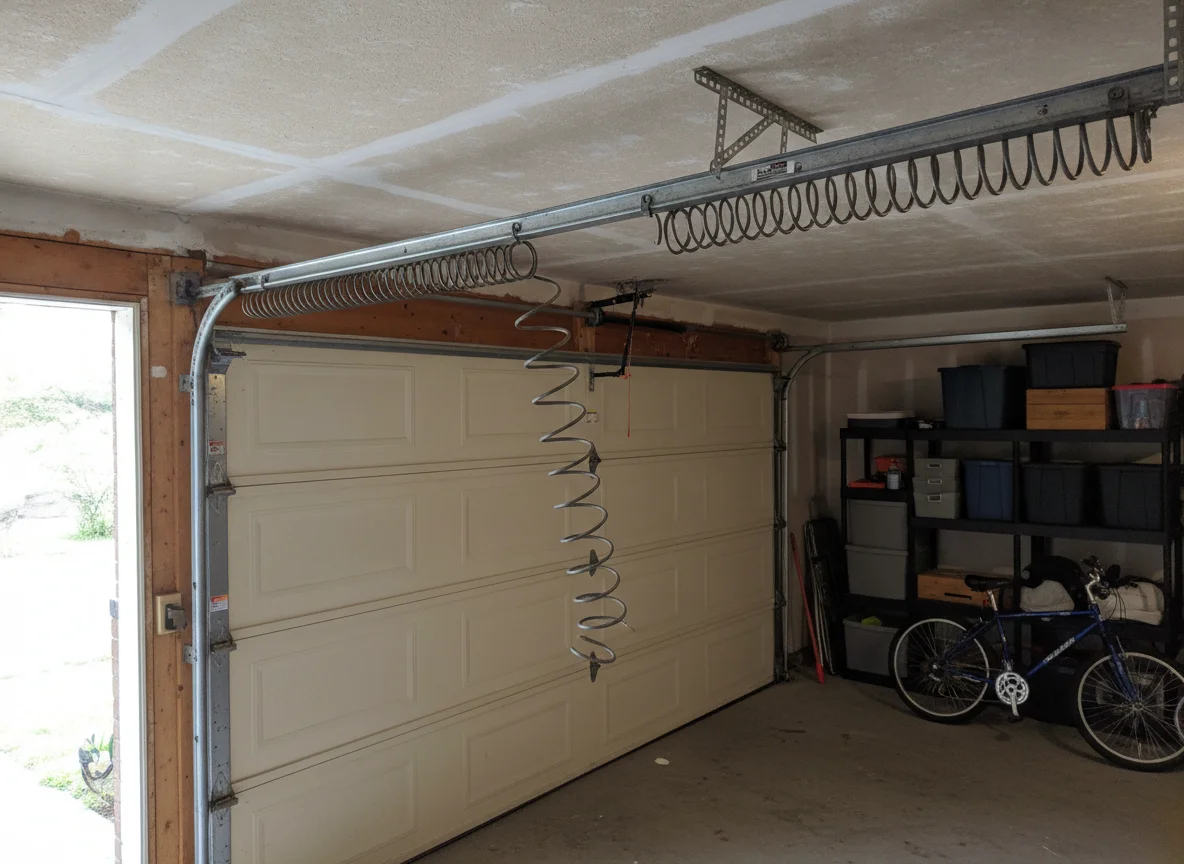
Telling if a spring snapped
A bang that sounds like a gunshot in the garage, often when nobody used the door. Tension peaks in a torsion spring while the door is down, which is when many of them give out.
A break in the coil
Peer at the shaft above the shut door. A failed torsion spring shows a tidy break, often several inches wide.
The door is suddenly heavy, or settles back down if you let go partway.
The opener groans, hums, or raises the door only an inch or two
Plenty of openers detect the heavier load and reverse, which makes them look like the culprit.
The door rises unevenly, one side trailing behind. Where a spring runs along each track, one of them has slackened off.
It drops fast across the final foot rather than easing to a stop.
Bang in the garage and the door won't rise? Don't try it; tell us what's visible over the opening.
Contact UsStaying safe until repair
Stored in a wound spring is enough energy to break bones, and a door whose spring has failed is hanging its full weight from what's left. Until the repair:
Don't wrestle the door up manually, and stop pressing the opener
Asking an opener to lift a whole door chews up its gears; repeated tries can strip them.
Don't use the release handle while the door is up
With no spring to hold it, the full weight can drop at once.
Don't try to ease off, crank or tweak a torsion spring
Winding cones are where the danger sits: the energy is stored there and most injuries happen there.
Send children and pets away from the door, and keep vehicles out if it is jammed partly open.
If a car is stuck inside, put that in your message.
Torsion versus extension springs
Torsion springs sit across the top of the opening on a long steel bar, coiling to store energy and driving the cable drums.
Most garage doors from the last few decades have torsion. They raise the door smoothly, and when one breaks it stays on the bar instead of flying loose.
Extension springs lie along each horizontal track and stretch as the door comes down; they turn up mostly on older, lighter doors. A safety cable must run through each one, or a broken spring can whip across the garage and hurt someone.
If one is absent, adding it is worth doing whether or not a spring has broken.
Plenty of older extension-spring doors can be changed over to torsion. Since the door is being worked on anyway, it's a sensible time to ask whether yours can.
What a spring repair involves
The dead spring is identified and sized up
Wire gauge, coil diameter, length and winding direction all have to match, or the door won't balance.
The weight of the door decides it
The right spring carries your own door's weight, not whichever one is nearest to hand.
The failed spring is taken off under control, its tension let go before bolts are undone.
The new spring goes on and is wound or set; both lift cables are then checked on their drums so the door rises level.
Balance is checked and the door tested
With the opener unhooked, the door should stay where you leave it around waist height, then run cleanly open and shut under power.
Describe what the door does
Two plain sentences are plenty to start; don't worry about knowing the failed part's name.
One spring, or the pair?
Two springs on one door have both lifted it the same number of times. When one snaps, the other is usually next in line to go.
Fitting both at once spares you a second visit and holds the door in balance, because a fresh spring beside an old one pulls out of step.
Ask your provider what they'd choose for your door and their reasoning. If yours runs on one spring, find out whether two would serve it better.
What the bill for spring work hinges on
Torsion or extension, and the number of springs on the door.
Door size and weight
Springs for a double door, a wood door or an insulated steel door must be heavier than those for a light single.
Cycle rating of the spring
Each spring is built for a stated number of open-and-close cycles. Higher-rated springs cost more up front and pay back on a door used all day long.
Other worn parts
Cables fraying at the drums, dragging rollers and worn shaft bearings are all cheaper to deal with on the same visit as the spring work.
Swapping extension springs for torsion, if you go that route.
How long do springs last?
How much it's used counts for more than age. A spring built for a set number of cycles lasts years longer on a seldom-used door than on the one the whole household walks through every single day.
Cold piles on the strain: January lows in Portsmouth average about 16°F, so the first hard freeze often claims a tired spring.
When springs fail early, a higher cycle rating may be worth asking about.
The added cost is normally minor next to a repeat repair.
When the spring is fine
The spring looks fine, but the door is crooked or a cable has gone slack
Go to garage door cable repair.
The door lifts by hand without effort, but the opener stalls
That one is garage door opener repair.
Questions people ask
Is changing a garage door spring a job for me?
Extension springs, with safety cables in place and the door held open and clamped, are within some homeowners' reach.
Torsion springs are not. They need proper winding bars and the exact spring specification, and one slip sends the stored energy through your hands. The Portsmouth Inspection Department treats door repair as ordinary repair, with no permit application.
Can I lift the door to drive out?
Not safely, not with a broken spring. Keep the door shut and let us know a car is inside.
What makes a spring break when the door's idle?
A spring loses a little life every cycle, and a torsion spring is under most tension with the door down. The final break often comes then, helped by cold-stiffened steel; Portsmouth gets about 65 inches of snow a year.
Is a new opener needed after a swap?
Seldom. If the opener was fighting a broken spring for a while, though, have its gears looked over for stripping.
More from the services list
Garage Door Cable Repair
Lift cables worn through, snapped or slipped, and a door that sags.
Read more →Garage Door Opener Repair
Openers that hum, reverse or ignore you, and a new unit when repairing isn't sensible.
Read more →Garage Door Maintenance
A seasonal check on springs, cables, rollers and the door's auto-reverse, ahead of any breakdown.
Read more →Reach out
Let us know whether the door is single or double, what you heard, whether it moves at all, and whether a car is trapped.
A floor-level photo of the spring above the closed door lets us identify the spring type and where it broke.